
You see yon precipice? Pillar Rock 1826
Two hundred years ago this week, Ennerdale shepherd John Atkinson made England’s first-ever rock climb.

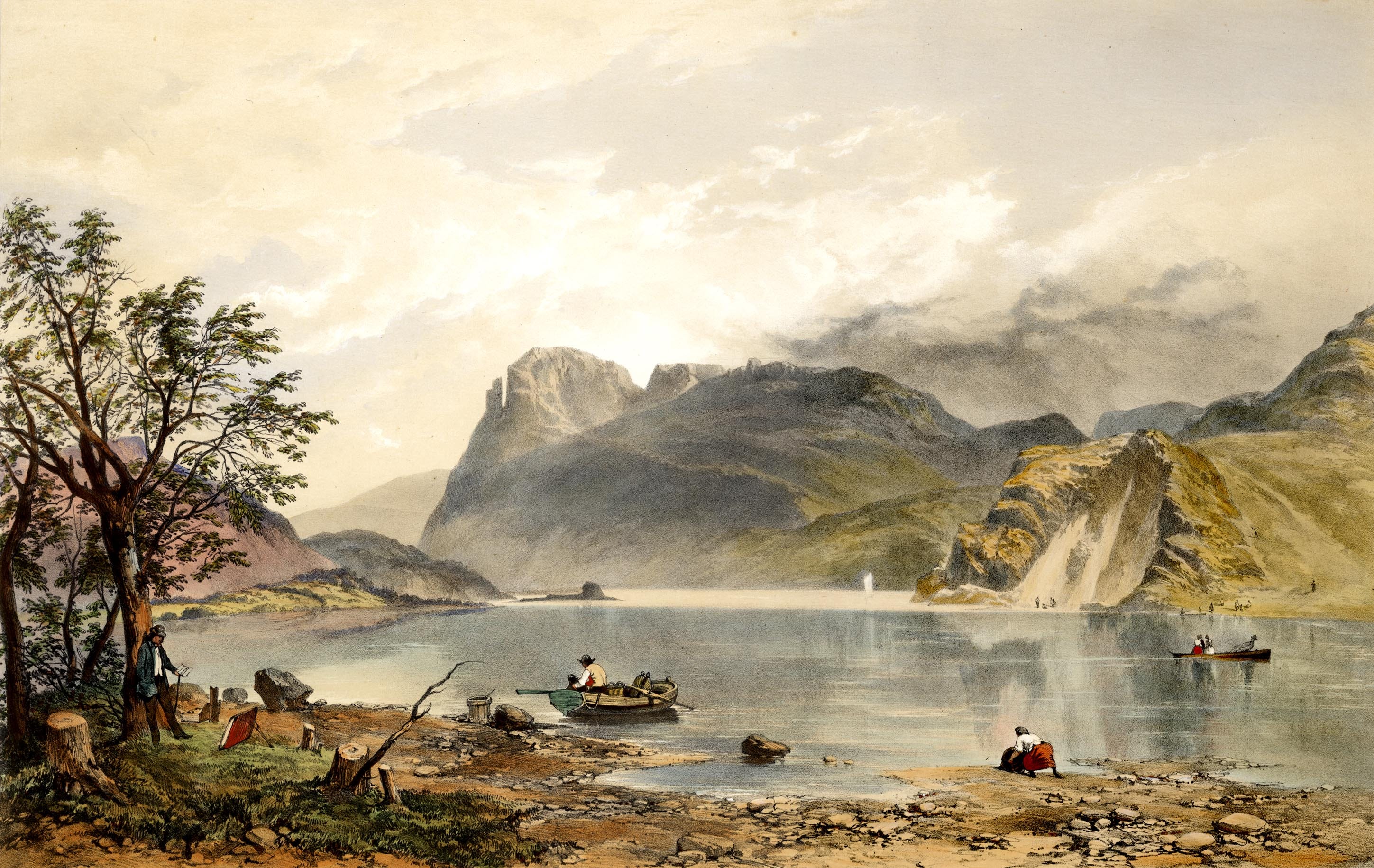
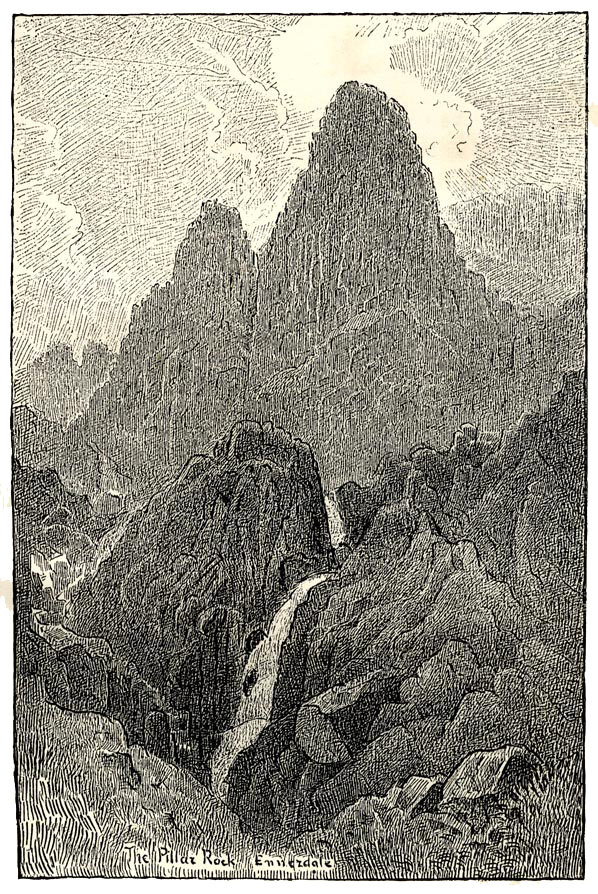
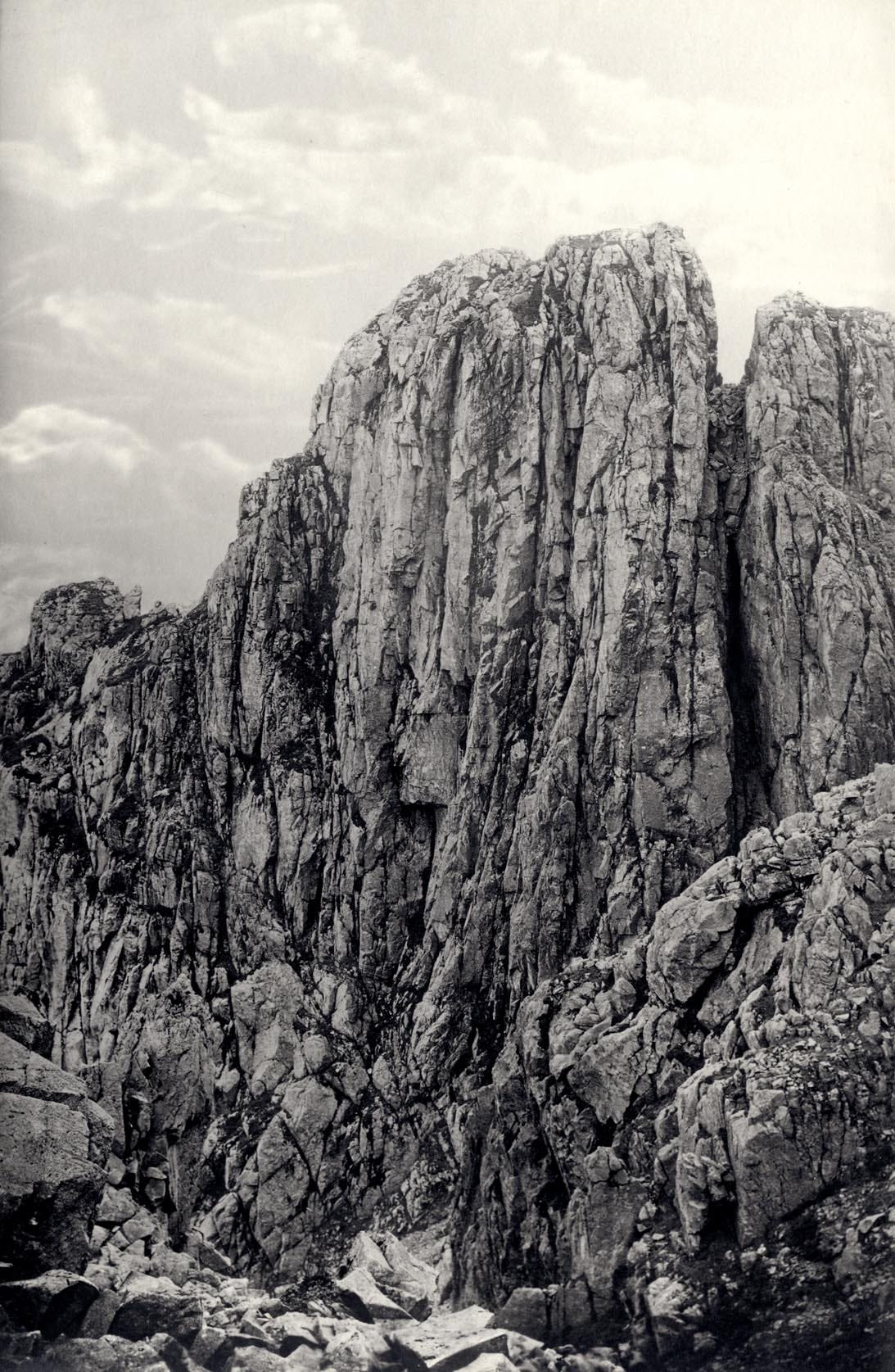
In Ennerdale, away on the southwest edges of the Lake District, is Lakeland’s most spectacular rock feature. The Pillar Rock, even though it’s 200m high on its downhill side, is surprisingly non-obvious from anywhere that you’re likely to be. Even from Haystacks, directly opposite, it can be easily missed because of the way it lies back against the equally rocky north side of Pillar Mountain.
One place you do see it from, five miles away, small but silhouetted against the sky, is the bottom end of Ennerdale Water. The place to stand is a quarter-mile downhill from the small sheep farm called Croftfoot.
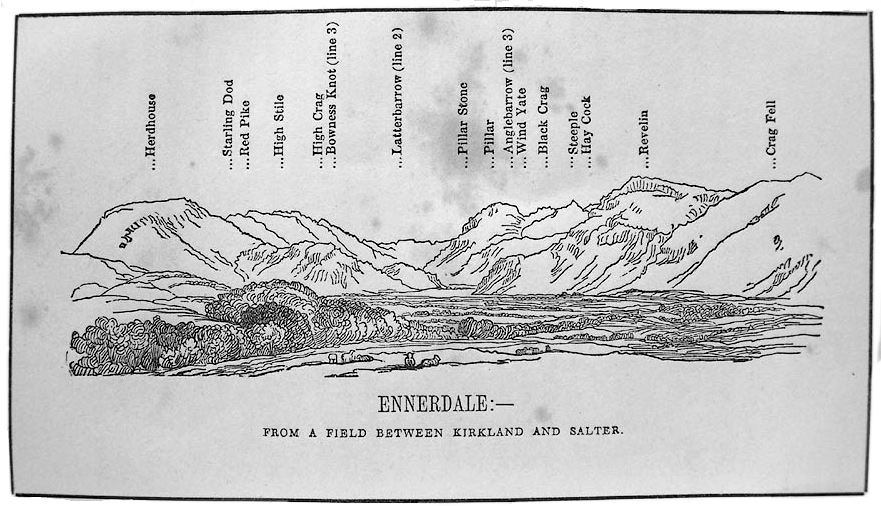
And from the floor of Ennerdale, once you’ve found a gap in the trees to look up at it through, the thing is spectacular.
You see yon precipice—it almost looks
Like some vast building made of many crags,
And in the midst is one particular rock
That rises like a column from the vale,
Whence by our Shepherds it is call’d, the Pillar.— Wordsworth, The Brothers 1800
It was in 1802 it started to be better known: that was when Wordsworth published his sentimental poem about it. To save you grinding through 422 lines of blank verse: A former shepherd, after 20 years away at sea, returns to find his beloved brother died many years before by falling off the Pillar Stone.1
But what really made the difference was Jonathan Otley’s guidebook of 18232, where he wrote that the Pillar Stone was inaccessible. Couldn’t be climbed.
The shepherd at Croftfoot, now in his early 50s, was a man called John Atkinson. Atkinson was also described as a cooper: it seems likely he had a side gig making or repairing barrels for the nearby Nether Hall at Ennerdale Bridge3. And from there it’s less than 10 miles to the busy port of Whitehaven. Anyway, he saw what Mr Otley had written in his guidebook –
And no man of spirit’s going to let a statement like that stand for long.
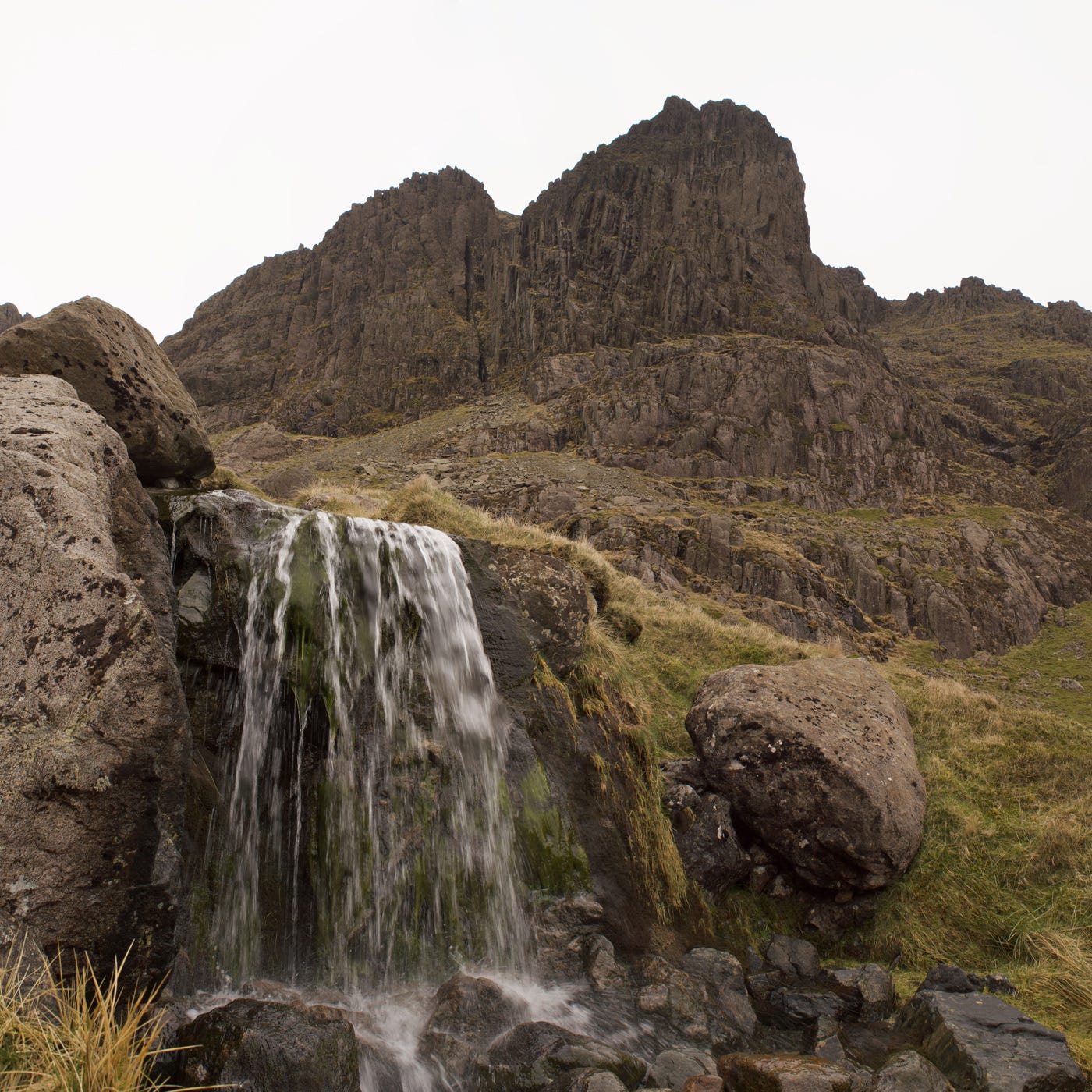
From the riverside, he’d follow a stream up between two bits of crag, the great Rock itself looming directly overhead. Above him, the stream runs down out of an intimidating waterfall gully, but here grass slopes lead steeply up to the left, to a grassy hollow that would be well known to any shepherd. At the top of this, he would slant up screes to left of the lesser crag now known as the Shamrock, then back left along its top. There he’d sit down on a stone to study the east side of Pillar Rock.
Alongside him, the subsidiary top called Pisgah: an easy scramble, but separated from the main rock by the deep Jordan Gap.
[Pisgah was were Moses looked across the Jordan valley to the Promised Land, aware that he would never reach it. See question xxx in my Quiz last Christmas]
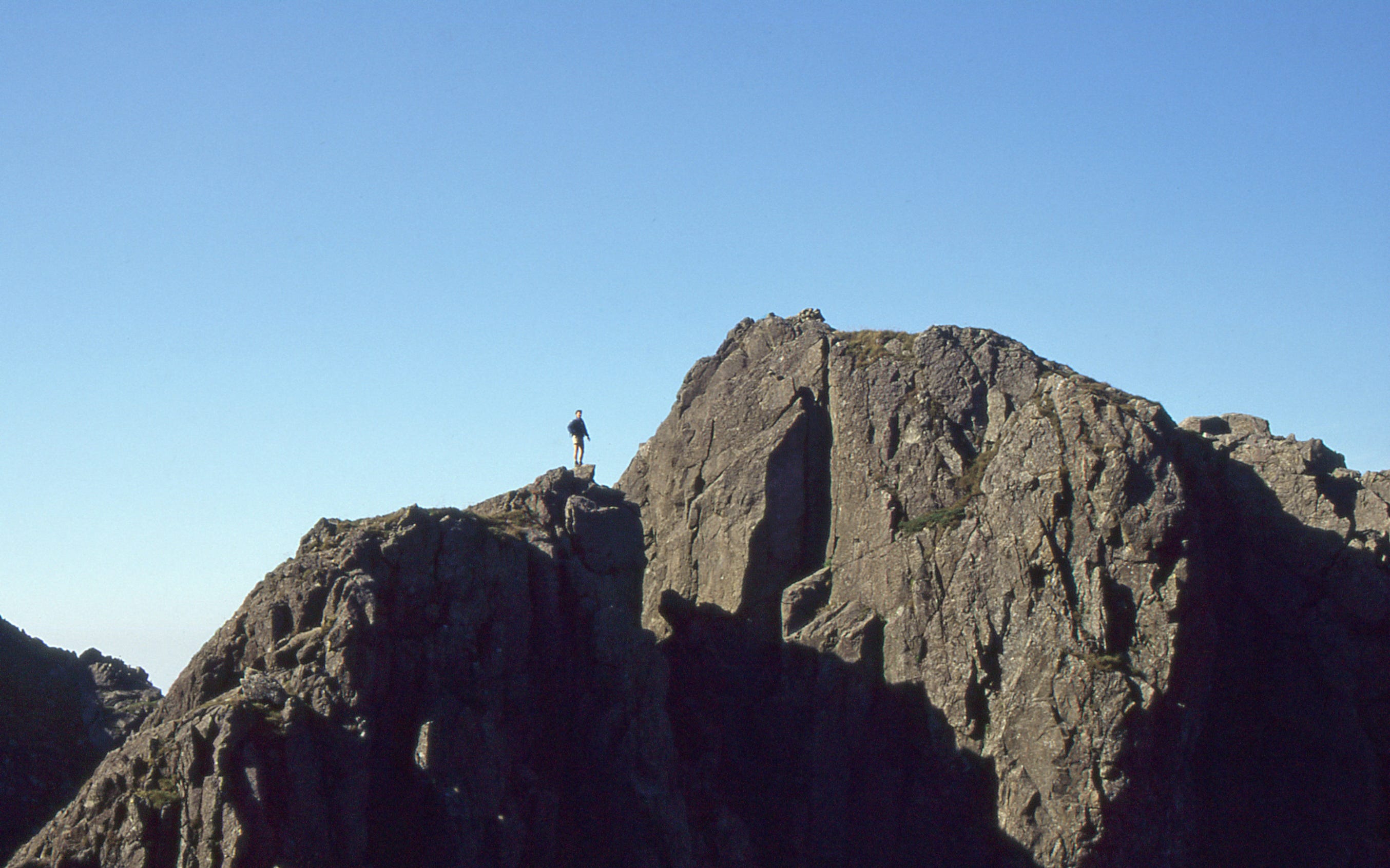
Heading across below the Jordan Gap, the main top, known as High Man, is only 100ft above. But those rocks are steep with no obvious line; the unexpectedly easy ‘Slab and Notch’ takes a devious line not seen from below. Meanwhile the lesser summit, Low Man, is actually now below him, but unreachable across a wall of rock.
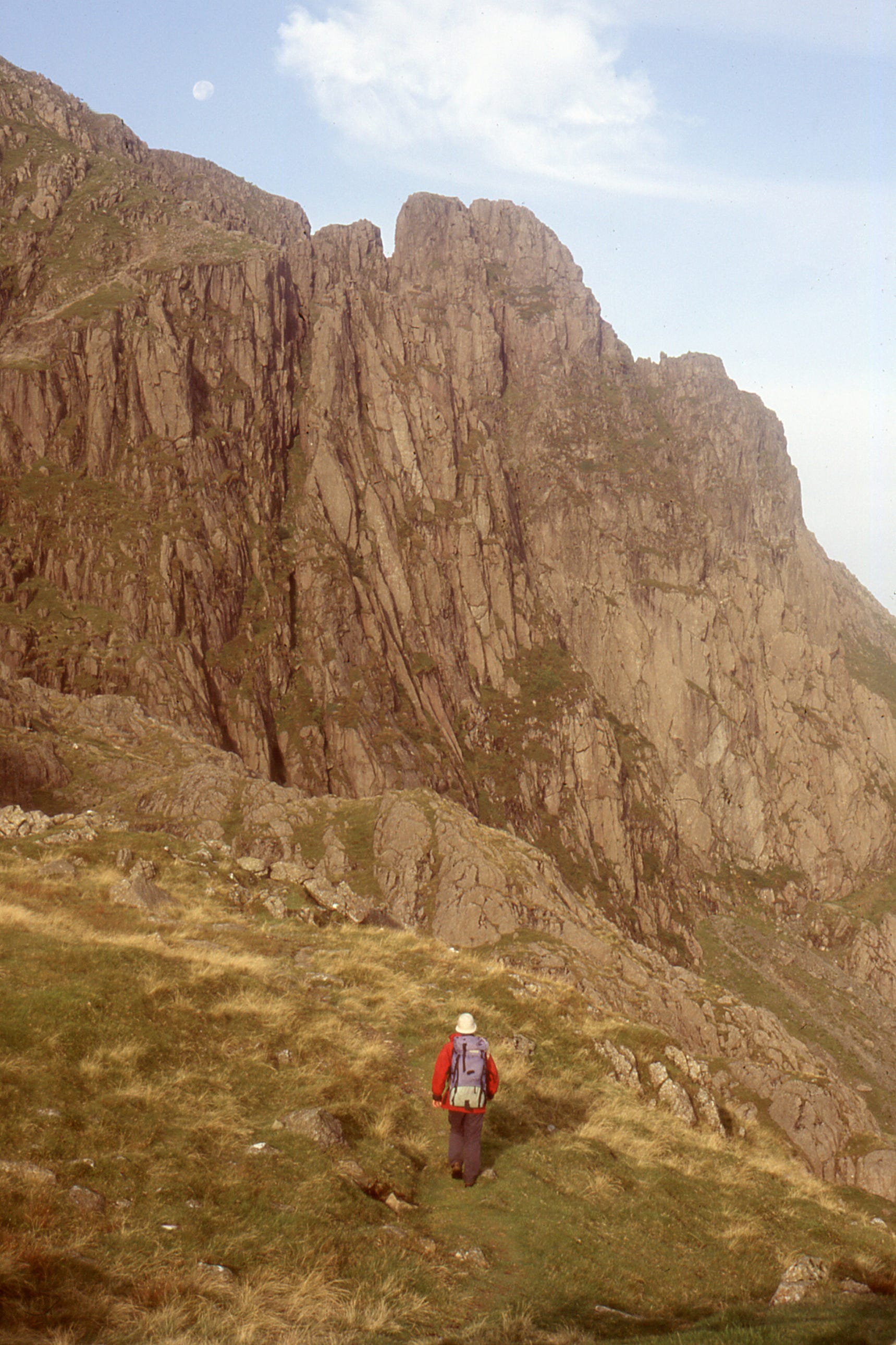
So he heads on up, to the narrow scree neck between Pillar Rock and its main mountain: and down the scree-filled hollow below the western face.
Which, if anything, is even more intimidating than the eastern one was.
But at the scree foot, which is also the top of the waterfall gully observed on his way up here: there he stops. Because from this point, a a shallow open gully, runs up to the left to the gap below High Man. It could perhaps be climbable.
Only one way to find out…
Slanting to the left, 10 yards of climbing up leaves him 15 or 20 yards above the scree. 50 yards: the holds are good but will he be able to find them again on the way down? He pulls lumps of mos and leaves them where they can be spotted from above. The holds run out. Thank goodness, he can go down now. But, sideways a little and to the left: yes, the way continues. Fifty yards and more of empty air below him now, the waterfall gully looking almost flat and level from this height – the holds continue, the slope eases.
A lump of moss to mark where he arrives on the grassy top of the Low Man rock. And he turns to assess the way on upwards…
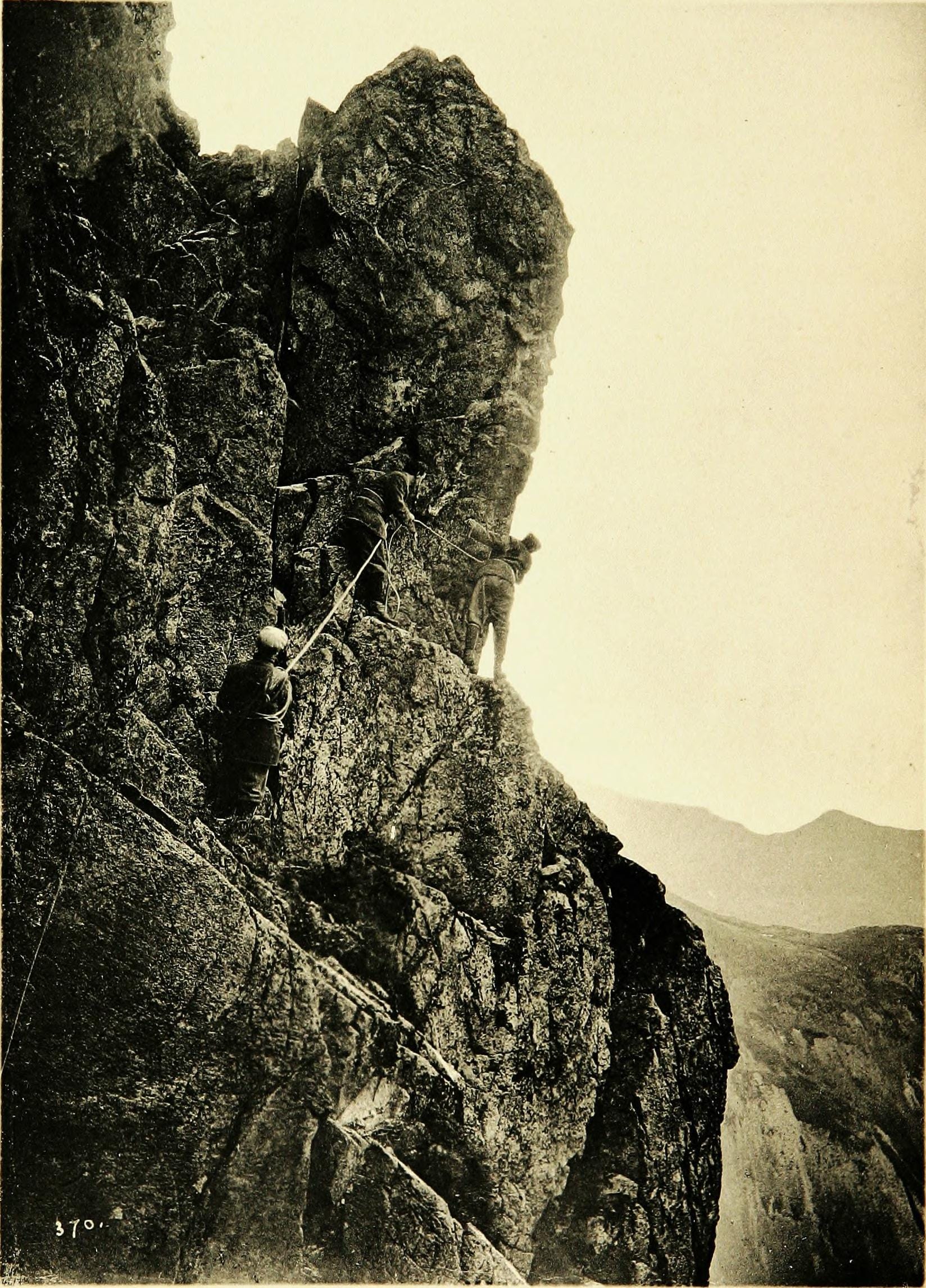
From the top of Low Man, the final rock face of High Man is now relatively short. It’s steep, but a handy crack, around a foot wide, runs right up the front of it, and there’s an even more handy handhold, big and spiky, to grab hold of on the way up.
Uncomfortably, though, that handhold isn’t actually part of the mountain: it’s a large jammed-in stone. One day, maybe, when somebody pulls on it it’s going to pull loose. And while the grass platform of Low Man isn’t too far below, it’s a platform that isn’t absolutely enormous, while on either side the drops go all the way down to the bottom of the Rock.
But what the heck. The day when that stone unjams itself probably isn’t today. (Okay, so I climbed that bit secured with a rope and a belay below.)
At the little rocky summit, a little patch of grass never seen by any sheep. No triumph and gratification here; as he still had to climb down again. He builds a small cairn. When they find his broken body, they’ll at least know he made it to the top…
Because climbing down is always more difficult. But he makes it, following the lumps of moss he’d left as route markers on the way up.
Once it’s been done, doing it gets a lot easier. Within a year, three other shepherds had followed him to the top: J. Colebank, W. Tyson, and J. Braithwaite
According to a brief note in the West Cumberland Times of August 8th, 18914, they may even have discovered a different way up on the eastern side. That would be the ‘Slab & Notch’ which became the usual descent route in the days when we preferred descending an easy climb to the somewhat dodgy delights of the abseil into the Jordan Gap.
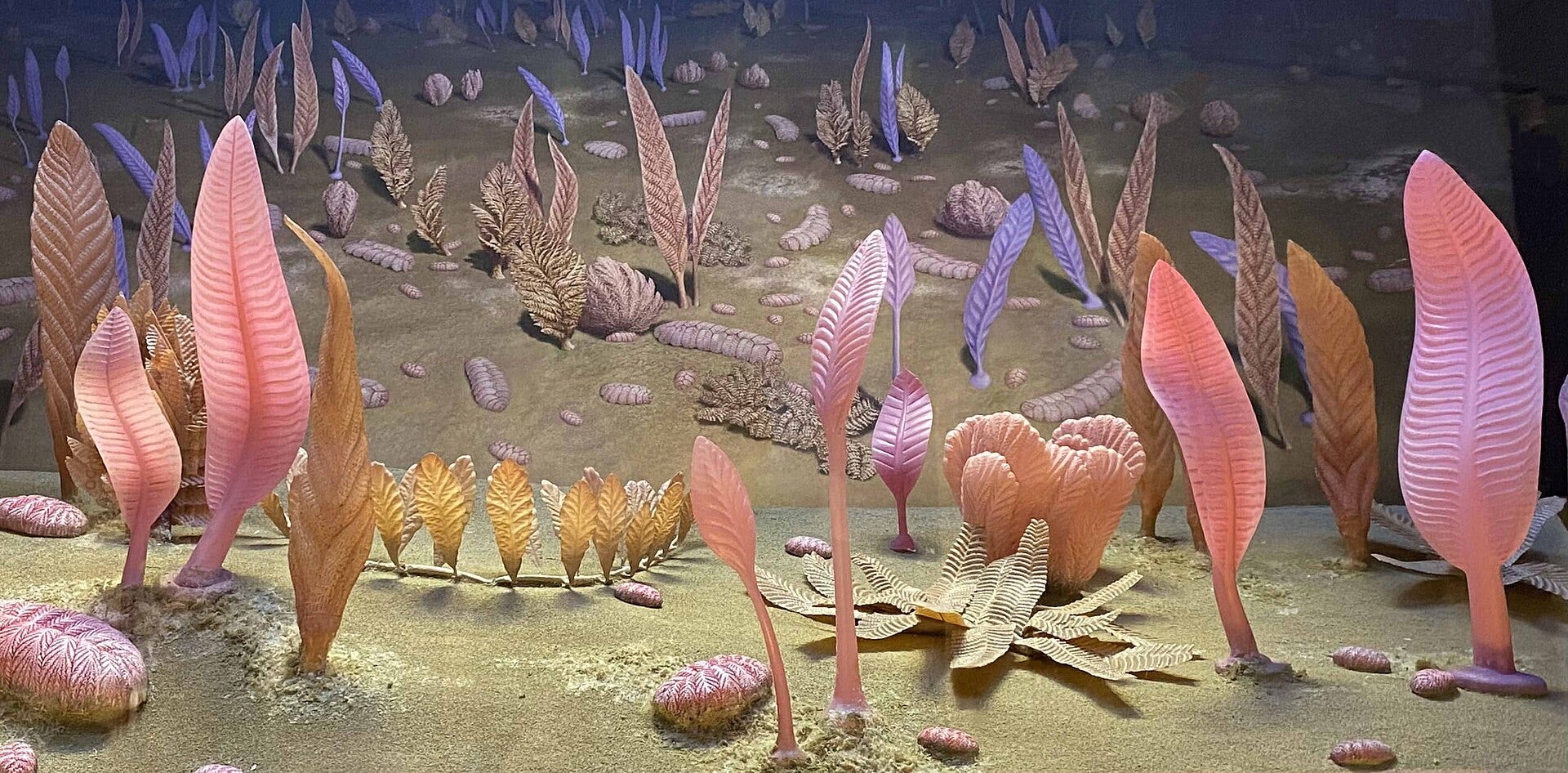
The ascent of Pillar Rock is counted as the start of rock-climbing in England5. But if so, it was something of a false start – a bit like the Ediacara fauna that flourished then died away again in the late Precambrian period.
It wasn’t until the 1848 that a new sort of climber arrived in Ennerdale. The upper-middle-class gents, and very occasional ladies, had discovered the fun of going up mountains in the Alps. But in the 10 months when the Alps were only good for the as-yet-undiscovered sport of skiing, they needed somewhere nearer home to stretch their nerves and fingertips.
And so, by the hundredth anniversary, there were 28 more climbing routes on Pillar Rock to add to Atkinson’s ‘Old West’ and the east side’s ‘Slab & Notch’. The reason Atkinson’s is the ‘Old West’ is the adjacent ‘New West’, an outstanding route at the grade ‘V. Diff’ which is to say suitable for not-particularly-talented climbers like me. After an easy introduction to get you off the ground, the chimney pitch is probably the hardest bit, but between reassuring rock walls. The climb then launches out to the right, on an open face of overhangs and dangling slabs. Somehow the route manages to slide right and left among the overhangs, always on good holds, with immense amounts of empty air directly underneath.
First ascent by the climbing-photographer Abraham brothers in 1901; back in 1969 we had to queue at the bottom of this classic. Today, less so: it’s a strenuous two hours up from the car park at Wasdale Head. I can’t find any ‘New West’ photos online that do it justice: it’s covered in Bill Birkett’s ‘Classic Rock’, but maybe it’s better just to head on up there and climb the thing.
Wordsworth claims it’s based on a true story: The poem arose out of the fact, mentioned to me at Ennerdale, that a shepherd had fallen asleep upon the top of the rock called The Pillar, and perished as here described, his staff being left midway on the rock. If correct, this would be the Rock’s true first ascent, 30 years ahead of John Atkinson and, indeed, ahead of Coleridge’s descent of Broad Stand in 1802. The detail of the stick found jammed in the cliff face is rather convincing. However, it seems unlikely that the shepherd would climb 200m of Grade 3 scrambling when the same hillside has plenty of more accessible crag tops for taking one’s last lethal sleep.
Renamed the Shepherd’s Arms, it’s a popular stopoff on Wainwright’s Coast to Coast Walk
No I haven’t been guddling around in ancient newspaper archives not yet digitised. These details come from the 1929 F&RCC Climbers’ Guide to Pillar Rock.
Unless, of course, the corpse in Wordsworth’s poem got there before.
It's a testament to great writing that this American who's not a climber and never been to Scotland so enjoys these stories About Mountains. Thanks.
Would have been handy sometimes, get the occasional near vertical grass slope up there...