
Chamber of Clouds
Ben Nevis, the only mountain ever to have earned a Nobel Prize. [1800 words 7 mins

I will clamber through the Clouds and exist.
John Keats, letter to Tom Keats 1818
In which category might Ben Nevis be winning any Nobel Prize? Peace, perhaps – there is that Peace Cairn at the top, an untidy intrusion it is too. But then, the Ben is celebrated in the history of climbing, from the Victorians up the long rock ridges of its great North Face to the likes of Tom Patey poking their iceaxes into the rime ice – despite its small size, Nevis is one of Europe’s hotspots for winter climbing. Or Literature – for it has the only SMC1 area guidebook devoted to a single hill, not to mention a summit sonnet by John Keats who climbed it in 1818.
No, it wasn’t any of these. Indeed, they haven’t so far even come up with a Nobel Prize in climbing. The prize turns out to be the one awarded in 1927 for Physics – shared with the mountain’s human collaborator, Mr. CTR Wilson, for their joint work developing the Wilson Cloud Chamber.
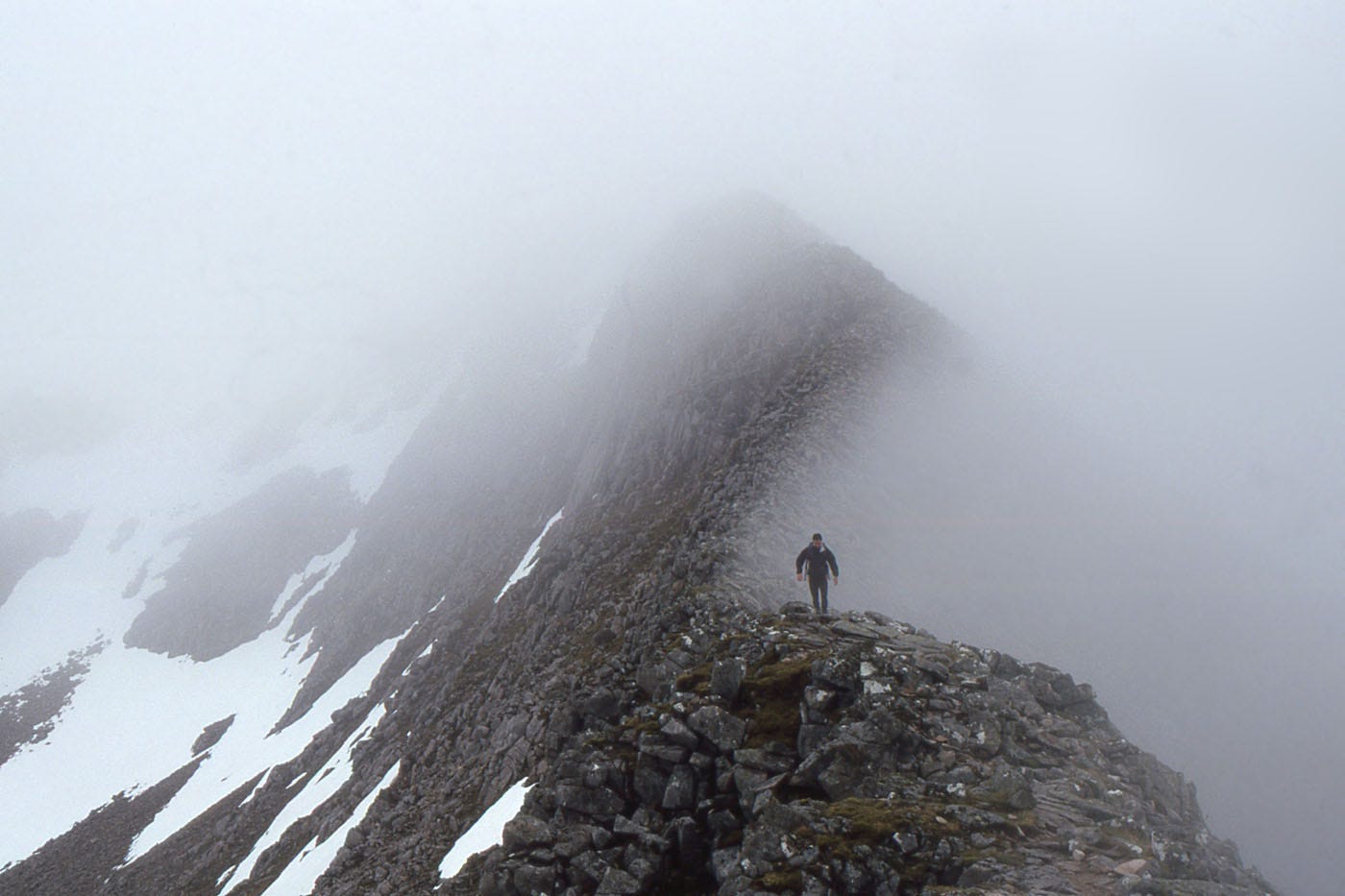
The thing that links Keats with CTR Wilson as well as with all that fabulous rime ice is of course the weather. The sea brings damp warm air, and damp warm air rises up the great North Face, cools, and condenses into cloud. Except that sometimes, unpredictably, it doesn’t cloud up at all – which, ten paragraphs further down, is going to be the whole point of the story.
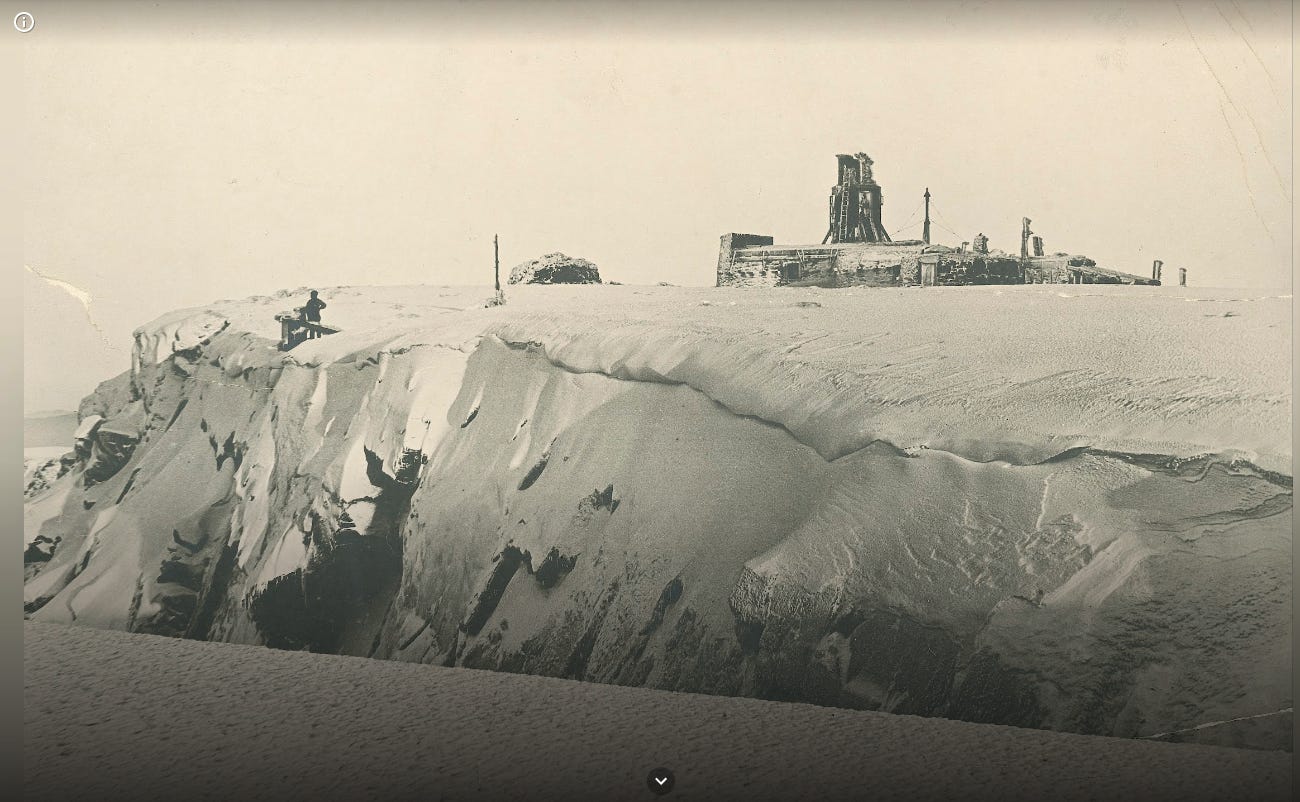
Sixty-five years after Keats’s climb, those earnest Victorians thought they’d build a weather observatory up there. For 20 years and 4 months it was manned (never of course womanned) in summer and winter. The present-day ‘Mountain Trail’ was its Pony Path bringing up building materials. The adjacent Gardyloo Gully, where the observers tipped their trash, is from ‘Gardez l’eau’, the traditional cry of Edinburgh householders before emptying the pisspot out of the window.
The inmates measured the wind and the rain and amused themselves with games of Who Can Find the Deepest Snowdrift. In the autumn of 1894, CTR Wilson, a Scotsman from the heart of the Pentland Hills, arrived for a fortnight – he was standing in for one of the regular weather guys.
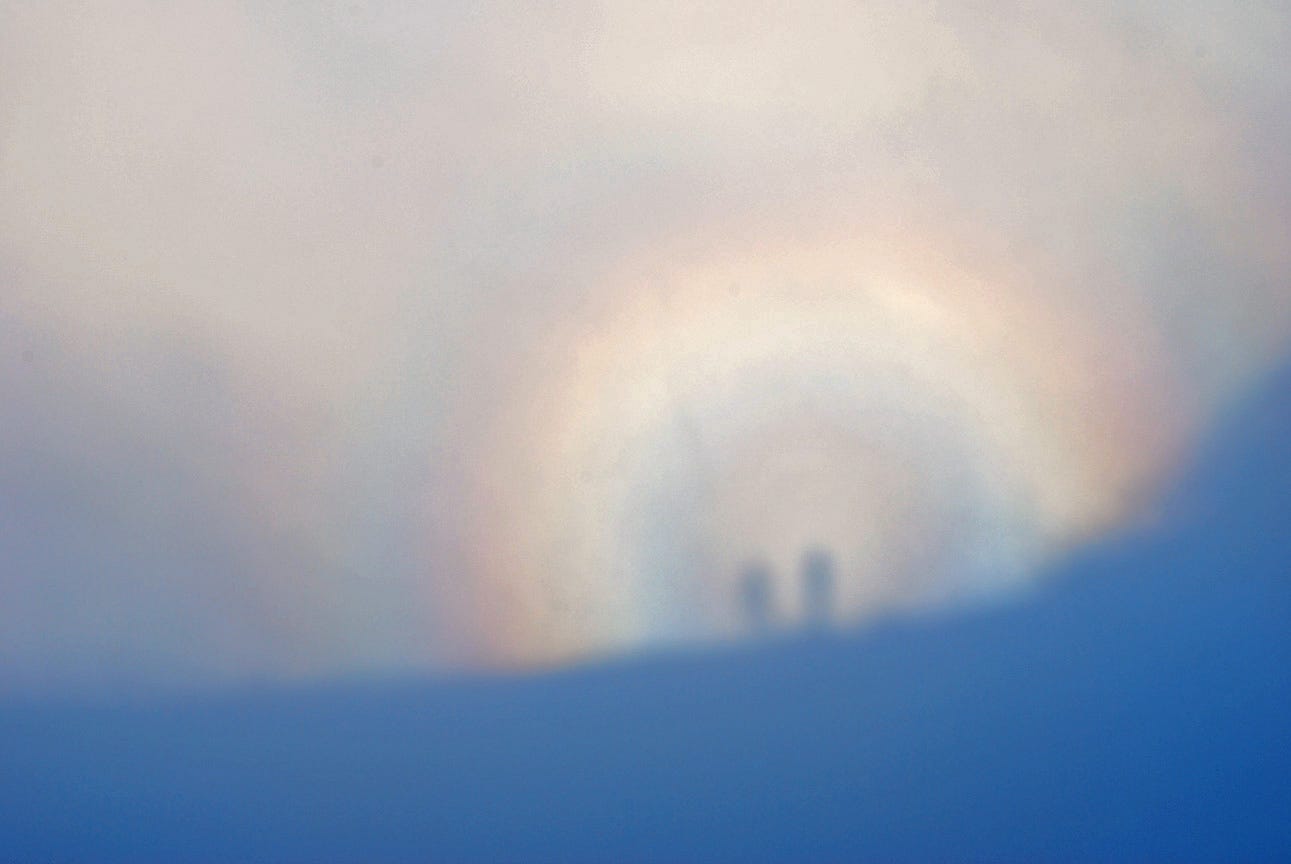
Looking at clouds isn’t so boring as you might suppose. Not if you’re Keats, putting together some fun rhymes and a thumping moral (sonnet in the footnotes2). Meanwhile Mr Wilson spotted a Brocken spectre. Well that’s what the stories say but I bet what he was really interested in was the glory, the glowing circles of coloured light which form around the head of your cloud shadow if the water droplets happen to be small enough and of uniform size – and which can only be explained by sophisticated application of Maxwell’s four equations of electromagnetism.
A fortnight, it turned out, wasn’t nearly enough. Back in Cambridge – and Cambridge is the most mountain-deprived place in the entire UK3 – he decided to build his own Nevis North Face, desktop size, right there at the Cavendish Laboratory.
In summer, the moist Atlantic air sweeps into Coire Leis, whose name translates as the Bowl of Dreams. It condenses into cloud, and then rain. Each droplet forms around a ‘nucleation centre’ such as a speck of dust or ice. Perfectly clean air can become super-saturated: it has more than enough moisture, at a chilly enough temperature to form clouds, but it can’t because no specks to condense around.
When moist air rises up Ben Nevis it expands due to the drop in pressure. As it expands it cools, eventually allowing the water droplets to appear. In Wilson’s cloud chamber, the pressure drop is achieved with a bicycle pump working backwards.
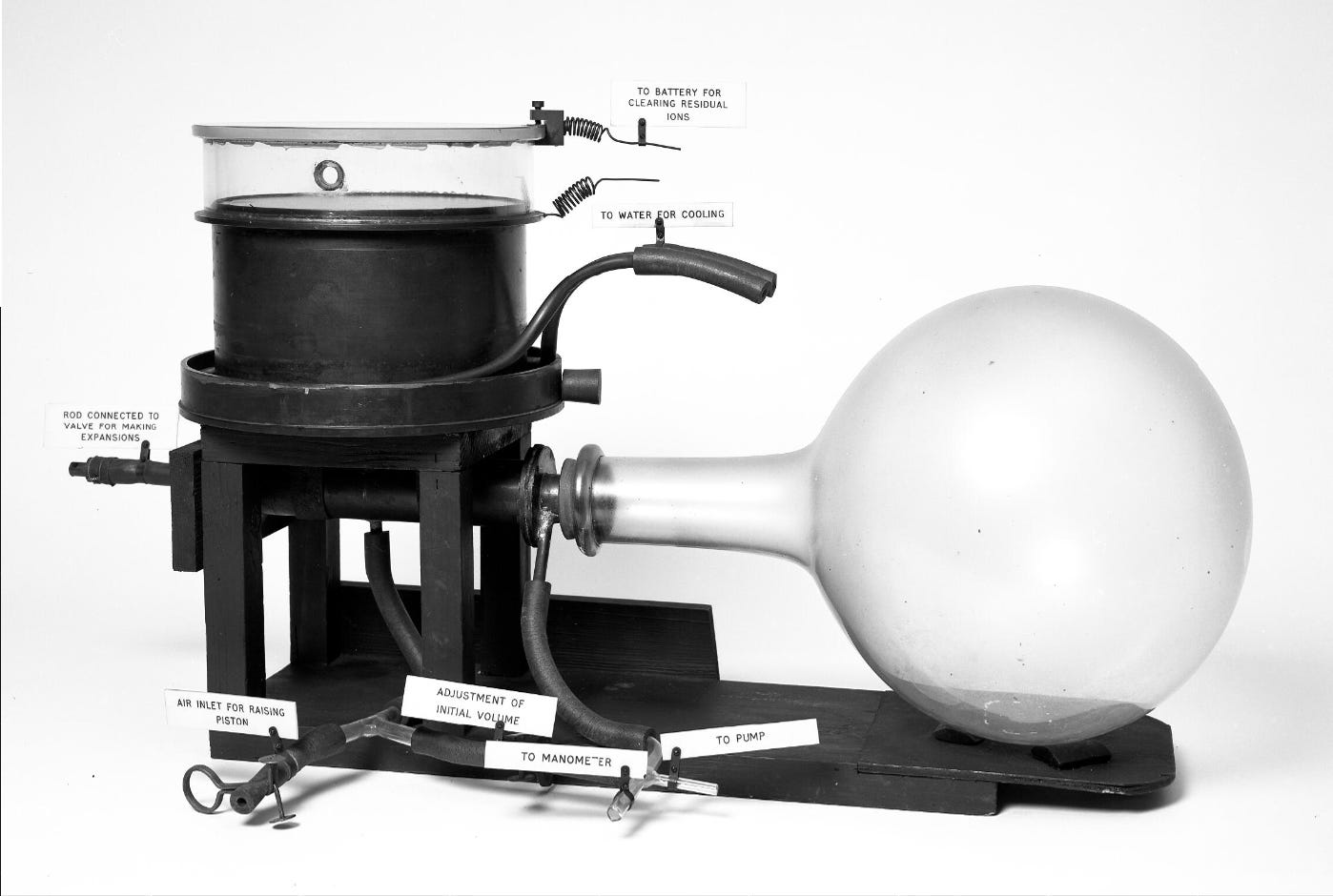
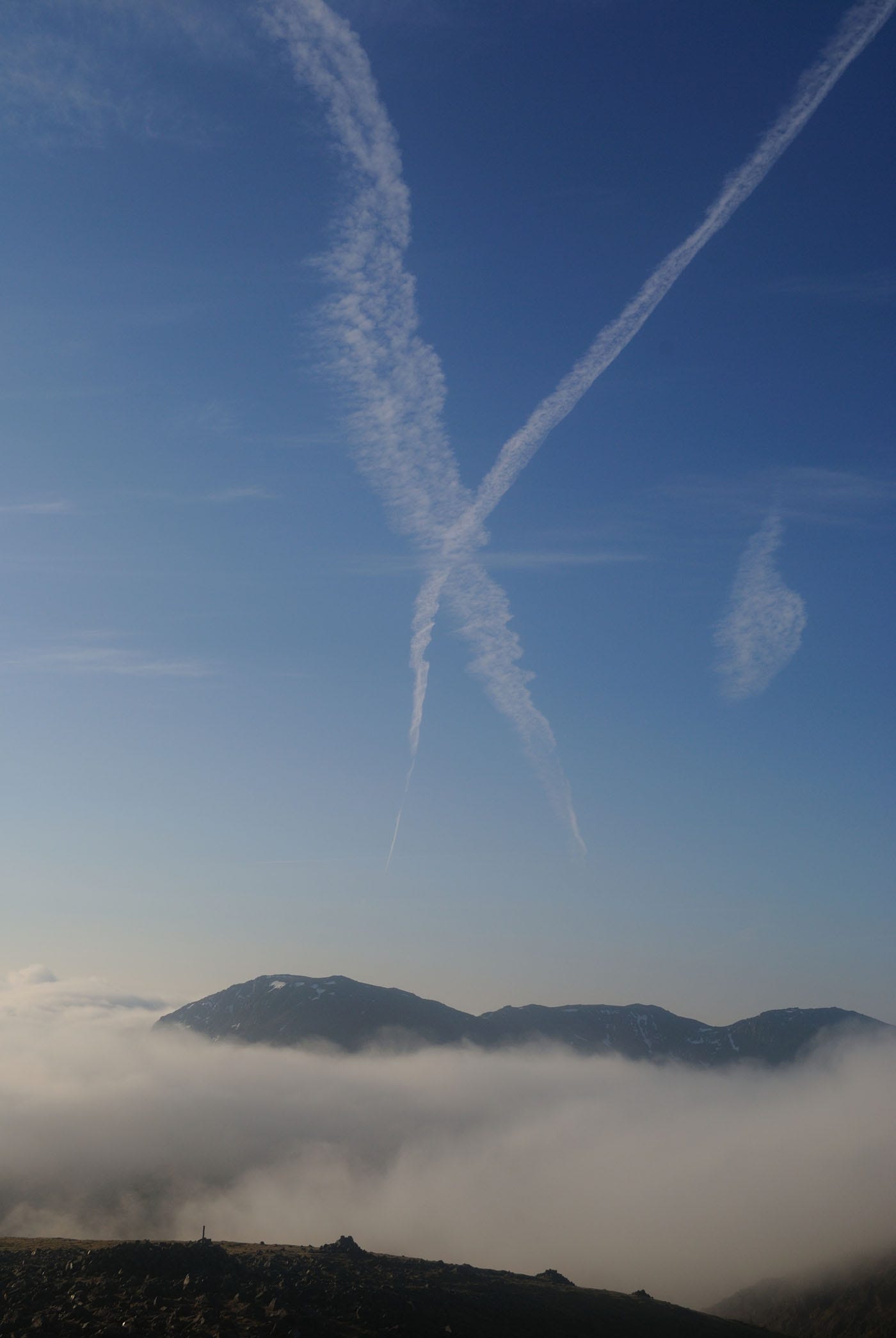
Imagine his surprise (actually those guys in the Cavendish are only slightly surprised when they come up with a fundamental breakthrough in physics…) when he saw straight-line streaks of condensation, randomly through his home-made cloudscape. The streaks looked exactly like the trails of very tiny jet aeroplanes, or would have done if only aeroplanes existed back then.
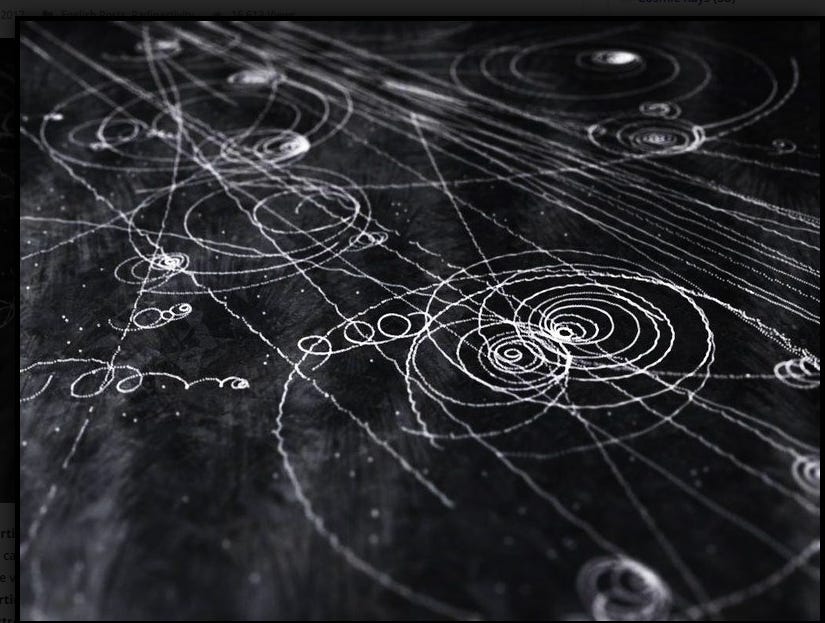
What he was seeing was, in fact, the trails left by the newly discovered Roentgen ‘rays’. Alpha particles, which are actually helium nuclei (two protons two neutrons), and beta particles, which are just electrons.
High-speed ‘cosmic ray’ particles given off by the sun zip down through the air. As they pass they knock electrons out of our gas molecules, and leave them electrically charged. These charged molecules form the condensation centres for visible droplets to immediately form.
It’s roughly the same process as a high-altitude aeroplane leaving a vapour trail rather larger than itself – with one difference. The scaling up factor is enormous. From electron to visible vapour, it’s as if a standard Boeing 747 left a vapour trail wider than the orbit of the Earth and visible, with a really good pair of binoculars, from another star.
And yes, you can do this at home. You’ll need a fish tank, some dry ice, a small amount of 90% isopropyl alcohol and a flashlight. “Use some heavy gloves” they suggest at Snolab Canada, as the dry ice is at –78° C. Also, “if you’re a youngish kind of person, have your parents buy and handle the isopropyl alcohol for you.”
Put the whole thing inside a strong magnetic field, and any particle with an electric charge on it will start going round in circles (strictly speaking, in helixes. Even more strictly speaking, in helices).
In 1937, but sadly not on the summit of Ben Nevis as the observatory had crumbled to ruin long before, a Mr Carl Anderson of Caltech on 2 August 1932 (the exact 114th anniversary of Keats’s ascent of Ben Nevis) spotted an electron going round in circles in the wrong direction. He’d discovered the plus-sign anti-electron, the ‘positron’. Theoretical physicists of the more adventurous sort (well, Paul Dirac) had said there jolly well ought to be an anti-electron – the kind of statement you can sometimes get away with on the basis that there’s no way anyone’s ever going to detect one.
For this he (Anderson, not Keats) won the Nobel Prize for Physics in 1936; the muon (an exotic heavy electron) revealed itself the following year.
The successor to the cloud chamber was devised while gazing into a glass of beer. Donald Glaser got himself a Nobel Prize for his bubble chamber in 1960. It’s a slight stretch to argue that beer drinking is a branch of hillwalking… But in 2014 a second hillwalking Nobel went to Prof. Peter Higgs of Edinburgh. It’s well known that he came up with his Higgs Boson while up in the Cairngorms.
I met with Professor Higgs after a lecture at the Royal Scottish Academy – we were both heading towards the tram stop in Princes Street. Naturally I wanted to know which specific mountain it was that gave birth to his boson.
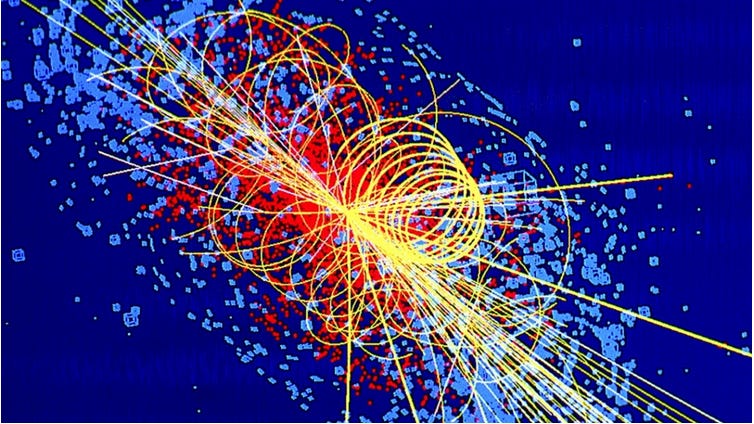
Disappointingly, this well known fact about the Higgs boson turns out to not be true. “I keep taking that down off Wikipedia,” the professor told me, “and Wikipedia keeps putting it up again.” Apparently saying ‘I know this about Professor Peter Higgs because I am Professor Peter Higgs’ is considered as merely anecdotal evidence.
Next hill-based Nobel? Economist Elinor Ostrom got her one in 2009 for studying the mountain village of Törbel, altitude 1502m, just off the Tour of Monte Rosa high-level hike. Scottish alpinist J. Michael Kosterlitz climbed the horribly misnamed Via degli Inglesi4 on Piz Badile, and perhaps its unstable weather and convolved route-finding led him towards the 2016 Prize in Physics for theoretical discoveries of topological phase transitions.5
Meanwhile Britisher Tom Thwaites gained a 2016 Ig-Nobel Prize for living as a goat among goats with a special set of prosthetic goat legs, on the high pastures of the Alps.
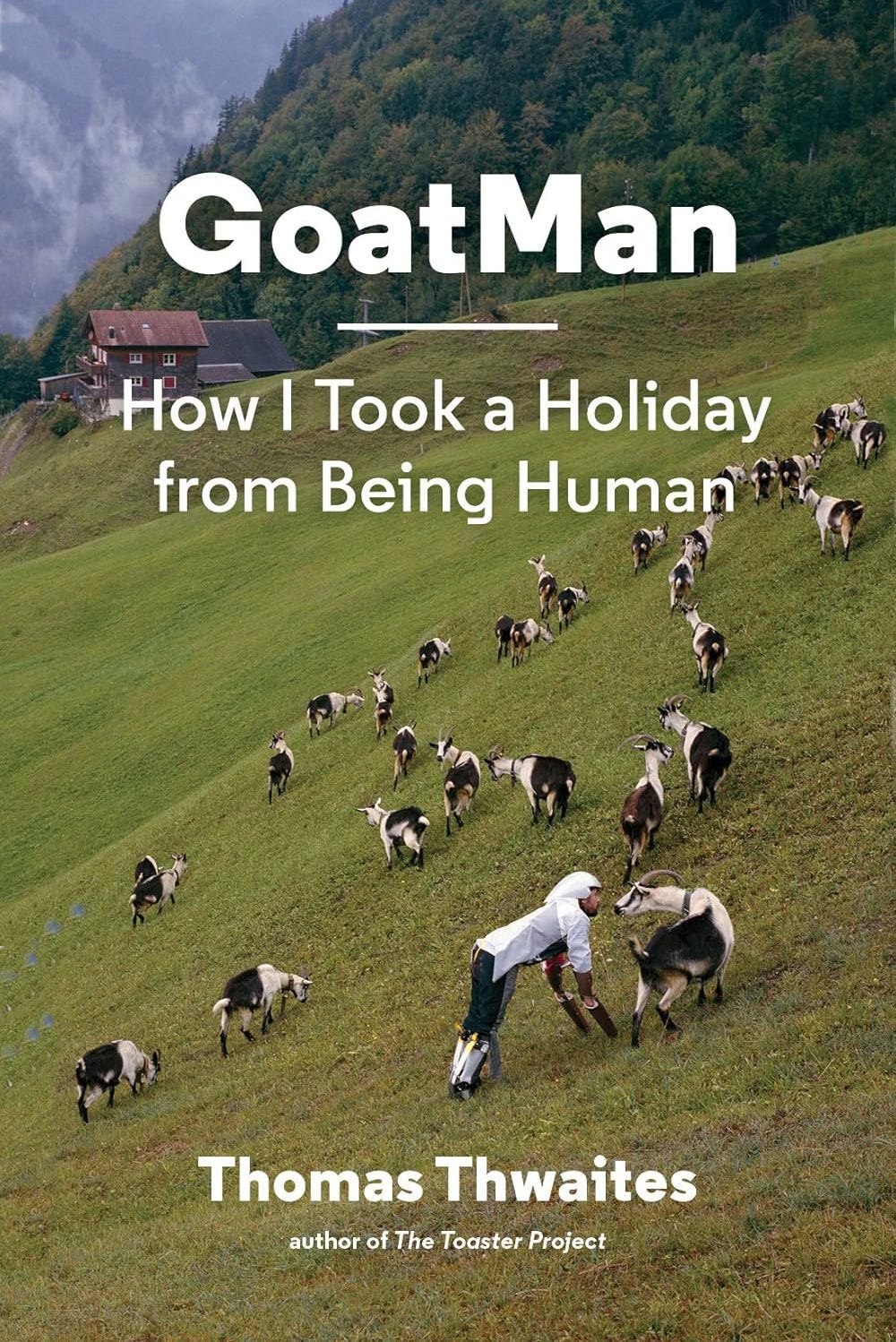
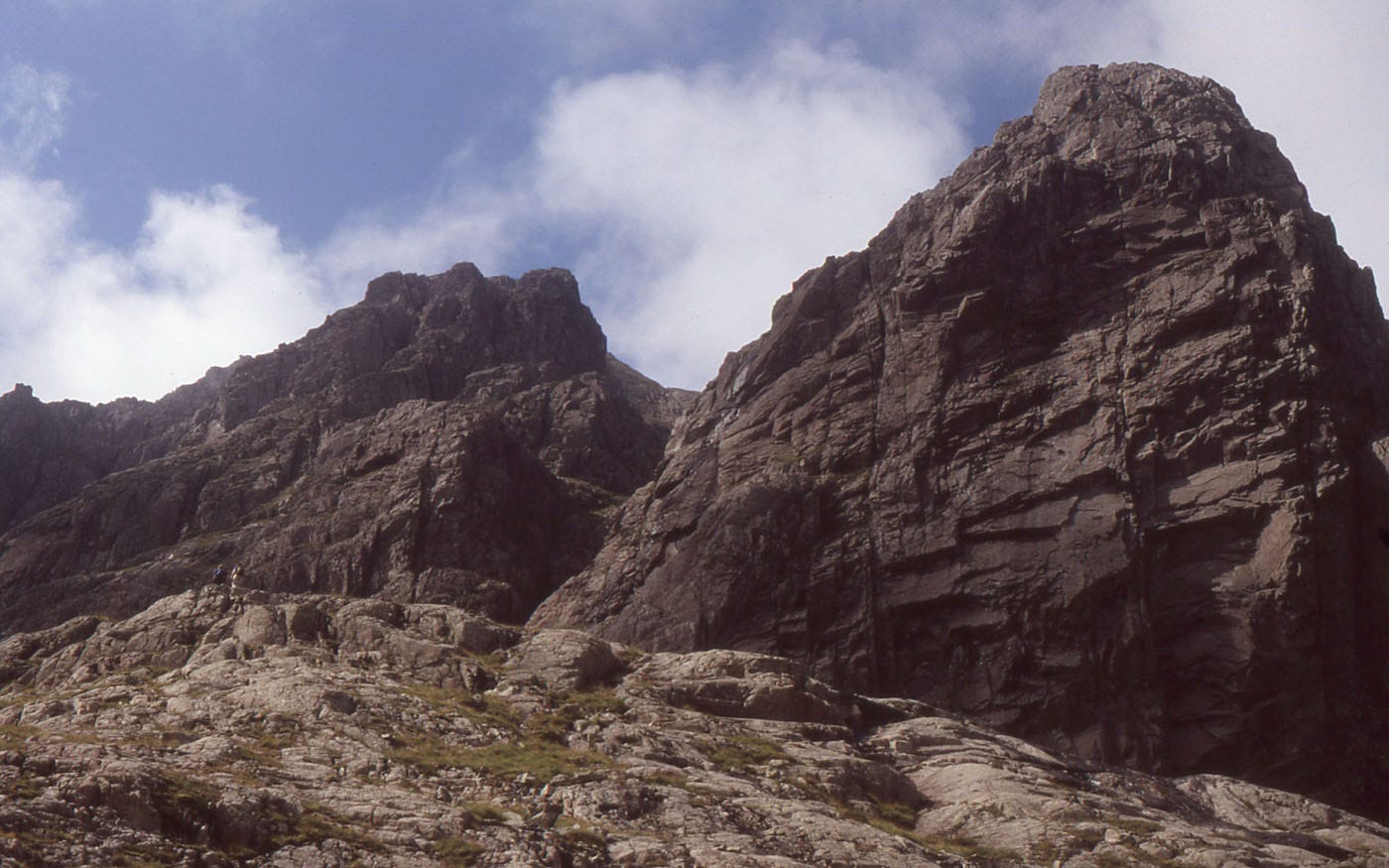
But the original and best, as well as biggest, is the cloud chamber formed by the great northern hollow below Ben Nevis.
See it swirl like daemonic porridge in the hollows of Coire Leis. Watch climbers suddenly silhouetted against the vapours as they top out on the Great Tower. Arrive at dawn, and behold the Brocken Spectre stalking across the top of Gardyloo Gully. Or be there overnight, sheltering in the rather smelly ruins of the observatory, and see the cloud backlit in bright orange by the lights of Fort William.
Happily, both for science and for lovers of grey and shady scenery, the top of Ben Nevis is cloudy almost all the time. It’s misty: it’s mysterious: and it certainly deserves its Nobel Prize. Discover the damp and soggy version of Heaven, as Keats did, on the cloud-chamber side of Ben Nevis.
Scottish Mountaineering Club, founded 1889
Sonnet. Written Upon The Top Of Ben Nevis (August 1818)
Read me a lesson, Muse, and speak it loud
Upon the top of Nevis, blind in mist!
I look into the chasms, and a shroud
Vapourous doth hide them, -- just so much I wist
Mankind do know of hell; I look o’erhead,
And there is sullen mist, -- even so much
Mankind can tell of heaven; mist is spread
Before the earth, beneath me, -- even such,
Even so vague is man’s sight of himself!
Here are the craggy stones beneath my feet,--
Thus much I know that, a poor witless elf,
I tread on them, -- that all my eye doth meet
Is mist and crag, not only on this height,
But in the world of thought and mental might!
Okay there is the Gog-Magogs, rising to their mighty 76m.
That’s Italian for English people’s Route. They did it again in the Dolomites, the Spigolo degli Inglesi climbed by SMC stalwarts Ling and Glover.
No I don’t know what those are either.
all of which reminds me of a trip to The Ben in the early 1960s:
…despite continuing bad weather, I went out in the afternoon with Barry Taylor, who hadn’t previously done much winter climbing. He wrote about it, saying, “We made our way to the Little Brenva Face with no intentions of doing any serious climbing. We didn’t even have crampons with us. Curtains of mist swallowed up the hut as we picked our way in solitude over boulders and across patches of snow that was becoming heartbreakingly sludgy due the fine drizzle. Although we could only see seventy feet or so in any direction we finally took a chance, how big a chance we didn’t yet know, to go for the summit.
Tony led the first pitch and I followed over a small crevasse and up a reasonably hard bit of rock to reach a sloping ice covered stance and belay on a peg hammered in between rock and ice. As Tony led on into the mist, I realised that the drizzle was not only making conditions desperate, but water was finding its way down my neck, up my sleeves and in though my cheap ex-army duvet which was soaking up water like a sponge. Whilst following the next pitch and trying to pass an off-balance move on some rock, there was a deep rumbling sound above. A distant ‘plane maybe? Or thunder? Then Tony shouted down, “Avalanche! Hurry up”. Luckily it passed us by and I reached the belay which was a sling that kept falling off a rock knob, and an axe stuck in snow like porridge. Tony went up again over snow and a blue ice bulge into which he hammered a couple of rock pegs that fell out immediately after he moved up. Avalanches were still coming down but he said the next belay was in a safer place.
It was, so we had our bit of food and some brandy. The mist was clearing, so we made for a ridge on the left, crossing a snow chute beneath dodgy looking cornices that were now in sight above. We reached the ridge in two more pitches, a harsh freezing wind hitting us as we climbed onto the edge, moving together on wind- crusted ice where crampons would have halved our time, a nerve wracking experience. Up on the top, whilst Tony was looking for his compass, I was fascinated by the noise made by the frozen surface of my duvet rattling in the wind. Descending, we found Number 3 Gully, but it looked bad, so we moved on to Number 4 which provided a splendid glissade. What a fabulous feeling, shooting down through the mist between the black walls of the gully. It had been a good day out after all. We discovered later that we had probably climbed Slalom, one of Ian Clough’s routes.”
Great read.
Of course you could have made a connection with Thomas Mann, but The Magic Mountain isn't really a mountaineering book…
One other tenuous connection I can think of is Fritjof Nansen; the crossing of Greenland was more than a bit mountain-y. But very far removed from the work that earned him the Peace Prize.